SHARE THIS WITH YOUR NEIGHBOURS
The fastest thing you can do today is forward this to three people who live under these flight paths. Most of them don't know what changed.
THIS IS HAPPENING NOW.
NavCanada implemented new flight paths in late 2025 that route hundreds of daily flights directly over Coquitlam, Port Moody, Port Coquitlam, New Westminster, and North Burnaby. Our communities are living with the consequences. It's time to reverse this.
Take Action Now See the Impact
These counters estimate aircraft overflying the Tri-Cities specifically, not total YVR landings. The estimate is derived from Vancouver Airport Authority's 2025 operating statistics (297,350 movements — about 407 landings per day for all of YVR), then adjusted for two factors that determine what actually goes over our communities:
1. Wind direction. Westerly winds prevail at YVR roughly 70–75% of the year. On westerly-wind days, aircraft land toward the west on runways 26L/26R — approaching from the east, over the mainland. On the remaining ~25–30% of days, easterly winds send arrivals over the Strait of Georgia instead, and Tri-Cities residents see almost nothing.
2. Routing. Even on westerly-wind days, not every arrival routes via the Tri-Cities corridor — some come from the south over Delta/Richmond, some from the north. Under NavCanada's Phase 1 VAMP changes (implemented November 27, 2025), a significant share now does.
Applying those factors to YVR's 407 daily landings yields an estimated ~250 Tri-Cities overflights per day on average across the year. On a busy westerly-wind day, the real figure is substantially higher (consistent with the community observation of one plane every two minutes during peak hours). On an easterly-wind day, it is near zero. Your own experience on any given day will vary.
Numbers are approximate. YVR publishes its actual statistics at yvr.ca, and individual flight tracks can be verified using FlightRadar24 or ADS-B public exchanges.
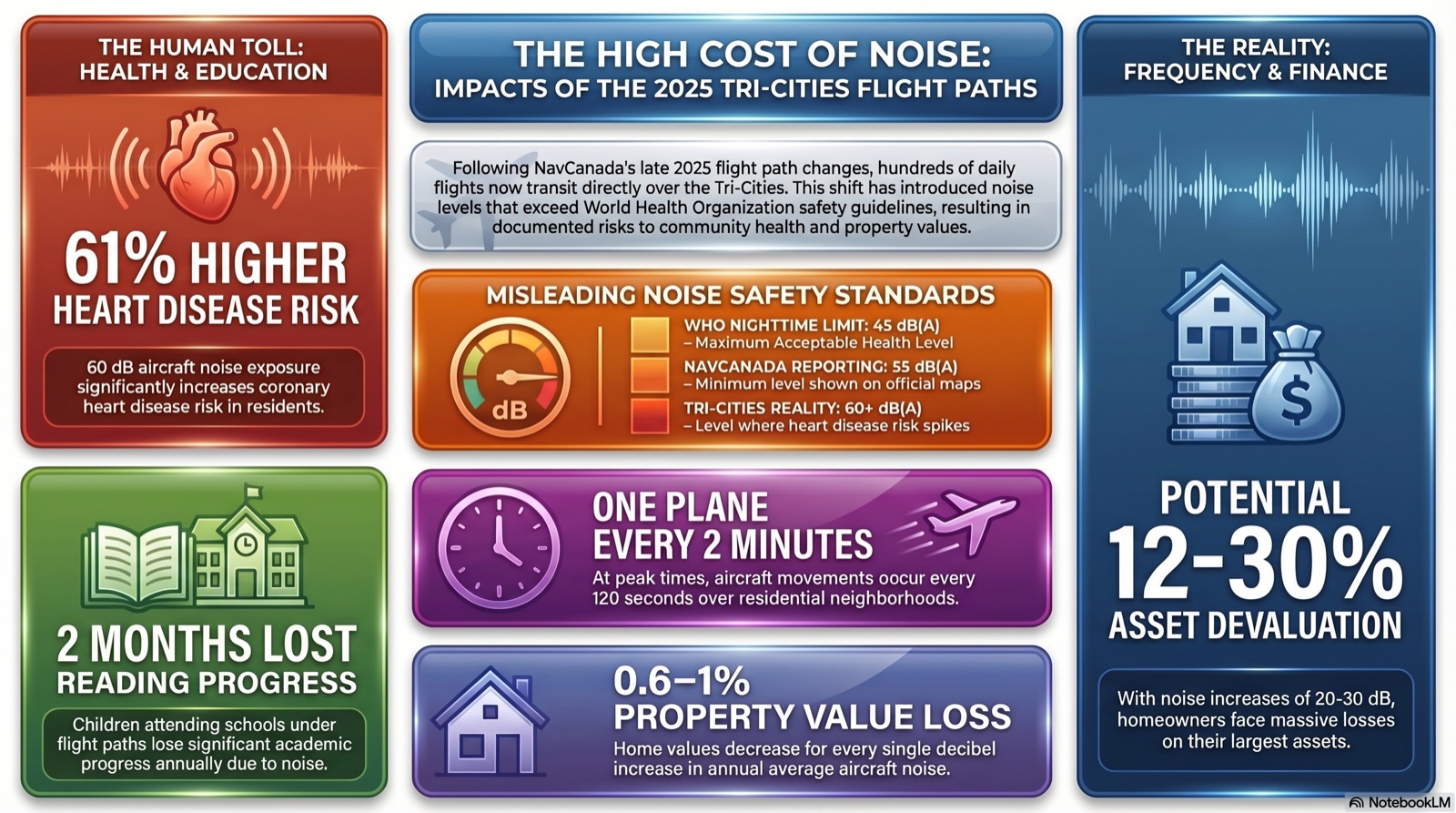
YVR handled 297,350 aircraft movements in 2025 — 148,675 landings. That is 407 landings per day, 17 per hour, one every 3.5 minutes on average, and every 2 minutes or less during peak hours.
German research found that 60 dB aircraft noise exposure increased coronary heart disease by 61% in men and 80% in women. Our neighbourhoods now exceed that level.
Children at schools under flight paths lose up to 2 months of reading progress per year. There are multiple schools directly under these routes.
The German Cologne-Bonn Airport study of more than one million insured residents found daytime aircraft noise at 60 dB(A) increased coronary heart disease by 61% in men and 80% in women. Our neighbourhoods now regularly exceed 60 dB(A).
Source: Greiser et al. (Journal of Public Health, 2007)A 2025 MIT/NBER study ("Planes Overhead") found a one-decibel increase in annual day-night average aircraft noise reduces house prices by 0.6 to 1 percent. With 20-30 dB increases over baseline, homeowners face potential losses of 12-30% on their largest asset.
Source: NBER Working Paper 34431 (MIT)The European Environment Agency estimates environmental noise — of which aircraft noise is a major contributor — causes roughly 12,000 premature deaths and 48,000 new cases of heart disease annually across Europe. Our communities now live with noise levels that feed into this burden.
Source: EEA Environmental Noise in Europe (2020)Parents, homeowners, and residents of the Tri-Cities. We accept no corporate funding. We just want our quiet neighbourhoods back.
These flight paths need to be reversed. Our elected officials at every level of government need to act now to protect our communities from a private corporation's cost-cutting decision.
The fastest thing you can do today is forward this to three people who live under these flight paths. Most of them don't know what changed.