NOISE HURTS
Aircraft noise has documented effects on health, sleep, and cognitive development. Here's how NavCanada's flight path changes are directly affecting you and your family right now.
HOW NOISE CAUSES DISEASE
The biological pathway is well-established in European research
Chronic Noise Exposure
Aircraft overhead every 4.5 minutes, day and night, at 55-70 dB
Stress Hormone Release
Your body releases cortisol and adrenaline — even while you sleep
Chronic Inflammation
Sustained stress hormones cause systemic inflammation and arterial damage
Serious Disease
Heart disease, stroke, hypertension, diabetes, depression, cognitive impairment
This pathway is documented by the WHO, the European Environment Agency, and confirmed by the NORAH, HYENA, and Swiss National Cohort studies.
THE IMPACTS YOU'LL FACE
Your Sleep Is Being Destroyed
Frequent aircraft noise wakes you throughout the night, preventing deep sleep and causing chronic sleep deprivation.
Your Children Are Falling Behind
There are many schools directly under the flight path. Chronic noise impairs reading comprehension and long-term memory.
You Now Have to Disclose Flight Path Proximity
When you sell your home, you are required to disclose proximity to flight paths, affecting resale value.
You Hear a Flight Every 2 Minutes or Less
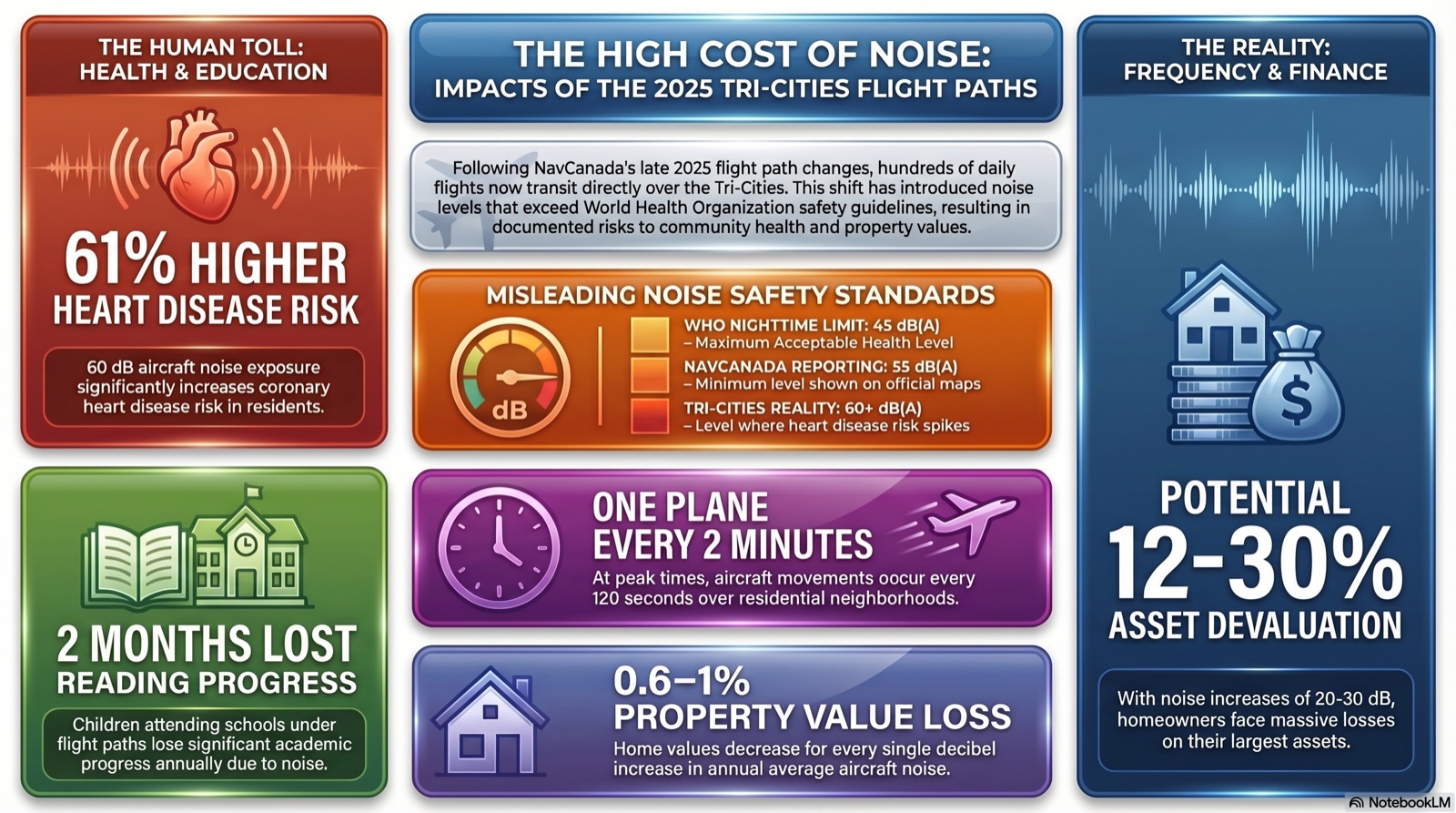
YVR had 297,350 aircraft movements in 2025 — 148,675 landings for the year. That is 407 landings per day, 17 per hour, one every 3.5 minutes on average, and every 2 minutes or less during peak hours.
Older Planes Are Much Louder
Most aircraft use older engines. They are significantly louder than the numbers stated in NavCanada's projections.
Air Pollution Has Increased Significantly
Burnt jet fuel particulate matter has increased substantially in your area, affecting air quality and respiratory health.
Pilots Have Broad Discretion
Flight paths shown in the proposal are approximate. Pilots can legally fly in areas not shown on the official maps.
Noise Models Don't Account for Elevation
Noise modelling is based on sea level. Planes will be louder in higher elevation areas than the models predict.
How Loud Is It Really?
Compare before and current noise levels
Reference Sound Levels
- 30 dB - Whisper, quiet library
- 40 dB - Quiet neighbourhood
- 50 dB - Normal conversation
- 60 dB - Busy traffic, vacuum cleaner
- 70 dB - Loud conversation, heavy traffic
- 80 dB - Loud alarm clock, heavy machinery
- 90 dB - Motorcycle, chainsaw
Measure It Yourself
Download a sound meter app to understand what these levels actually sound like:
THE RESEARCH IS CLEAR
The German Cologne-Bonn Airport study of more than one million insured residents found aircraft noise at 60 dB(A) increased coronary heart disease by 61% in men and 80% in women. Nighttime noise had an even stronger effect. Our neighbourhoods now regularly exceed 60 dB(A).
Source: Greiser et al. (Journal of Public Health, 2007)The RANCH study across 3 countries (UK, Netherlands, Spain) followed 2,844 children aged 9-10 near major airports. Every 5 dB increase in aircraft noise cost children measurable reading-comprehension progress. Multiple Tri-Cities schools sit directly under these flight paths.
Source: Stansfeld et al., The Lancet (RANCH Study, 2005)The WHO calculates environmental noise across Europe — with aircraft as a major contributor — drives over 900,000 new cases of hypertension and tens of thousands of hospital admissions each year.
Source: WHO Burden of Disease from Environmental Noise (2011)A Swiss study of 24,886 cardiovascular deaths found nighttime aircraft noise increased cardiovascular mortality by 44%. The effect was strongest for heart attacks and arrhythmia — your body reacts to noise even while asleep.
Source: European Heart Journal (Swiss Cohort)The HYENA study across 6 European countries found a 10 dB increase in nighttime aircraft noise raised hypertension risk by 14%. In men, the effect was even stronger — up to 54% in the highest exposure areas.
Source: HYENA Study (Environmental Health Perspectives)A BMJ study of 3.6 million residents near London Heathrow found stroke hospital admissions were 24% higher in the noisiest areas. Coronary heart disease admissions were 21% higher. A clear dose-response relationship.
Source: BMJ (Heathrow Study)Germany's landmark NORAH study — the largest aircraft noise health study ever conducted — found depression risk rose 8.9% for every 10 dB increase in aircraft noise. Aircraft noise had a stronger effect on depression than road or rail noise.
Source: NORAH Study / PLOS ONEYOUR MENTAL HEALTH IS AT RISK
Aircraft noise doesn't just damage your body — it damages your mind
Depression
The NORAH study found aircraft noise drives the highest depression risk of any transportation noise source — 8.9% more depression per 10 dB increase. Our communities now live with 15-30 dB increases over baseline.
Anxiety and Chronic Stress
Constant noise triggers a sustained fight-or-flight response. Your body cannot adapt — cortisol levels remain elevated, leading to chronic anxiety, irritability, and difficulty concentrating.
High Annoyance as a Health Outcome
The WHO recognizes "high annoyance" from aircraft noise as a clinical health outcome — not a nuisance, but a measurable predictor of cardiovascular disease and mental health decline.
Quality of Life Destruction
You can't enjoy your backyard. You can't sleep with windows open. Conversations are interrupted every few minutes. This isn't a minor inconvenience — it's a fundamental degradation of daily life.
OUR CHILDREN ARE PAYING THE PRICE
The Evidence From Europe's Largest Studies
Two landmark European studies — the RANCH study (3 countries) and the NORAH study (Germany) — have documented what aircraft noise does to children's development:
Air Pollution: Ultrafine Particles in Your Lungs
It's not just noise. Aircraft engines produce ultrafine particles (UFPs) — particles so small they penetrate deep into lung tissue and cross into your bloodstream.
What Science Says
Peer-reviewed research confirms the health impacts of aircraft noise:
WHO Guidelines on Environmental Noise
World Health Organization recommendations for aircraft noise exposure and health protection.
Noise Adverse Effects (PubMed)
Comprehensive research on adverse health effects from aircraft noise exposure.
Noise and Health in Urban Environment
Studies on cognitive impairment, blood pressure increases, and reading comprehension in children.
NOW TELL SOMEONE.
If you got this far, you understand the evidence. The neighbour who doesn't know yet is who matters next.
Every statistic on this page, cited
- Flight frequency (297,350 YVR movements, 407 landings/day, every 2 min peak): Vancouver Airport Authority 2025 statistics. yvr.ca
- WHO 45 dB(A) nighttime guideline & health-risk pathway: WHO Environmental Noise Guidelines for the European Region (2018). Read guidelines
- 61% / 80% higher heart disease risk (German Cologne-Bonn Airport study): Greiser E, Greiser C, Janhsen K (2007), "Night-time aircraft noise increases prevalence of prescriptions of antihypertensive and cardiovascular drugs," Journal of Public Health 15:327-337. Read study
- 2 months reading delay (RANCH study): Stansfeld et al. (2005), "Aircraft and road traffic noise and children's cognition and health: a cross-national study," The Lancet 365:1942-1949. Read study
- 900,000 hypertension cases / hospital admissions in Europe: WHO Regional Office for Europe (2011), "Burden of disease from environmental noise." Read report
- 44% higher cardiovascular mortality at night (Swiss Cohort): Saucy et al. (2021), "Does night-time aircraft noise trigger mortality? A case-crossover study on 24,886 cardiovascular deaths," European Heart Journal 42:835-843. Read study
- 14% higher hypertension per 10 dB (HYENA study): Jarup et al. (2008), "Hypertension and Exposure to Noise near Airports: the HYENA study," Environmental Health Perspectives 116:329-333. Read study
- 24% higher stroke risk near Heathrow: Hansell et al. (2013), "Aircraft noise and cardiovascular disease near Heathrow airport in London: small area study," BMJ 347:f5432. Read study
- 8.9% more depression per 10 dB (NORAH study): Beutel et al. (2016), "Noise Annoyance Is Associated with Depression and Anxiety — The Contribution of Aircraft Noise," PLOS ONE. Read study
- NORAH children's cognition findings: Klatte et al. (2017), "Effects of Aircraft Noise on Reading and Quality of Life in Primary School Children in Germany," Environment and Behavior. Read study
- 0.6-1% property value loss per decibel: Allroggen, Hansman, Knittel, Li, Wan, Wang (2025), "Planes Overhead: How Airplane Noise Impacts Home Values," NBER Working Paper 34431. Read paper
- Ultrafine particles & children's respiratory health near Schiphol: Lenssen et al. (2024), "Respiratory health effects of ultrafine particles from aviation in children," Environment International 188:108759. Read study
- Schiphol ultrafine particles & adult health: Dutch National Institute for Public Health and the Environment (RIVM). Read summary
- Aviation pollution & health impacts overview: Environmental Health Journal (2020). Read study
- Münzel review of noise & cardiovascular pathway: Münzel et al. (2017), "Environmental stressors and cardio-metabolic disease," European Heart Journal 38:557-564. Read review